Cruise Insurance vs. Travel Insurance: Which Is Better for Your Cruise?
January 9, 2026 - Meagan Palmer
Last Updated On:
Booking a cruise online or through an agency is a relatively straightforward process. You might already know where you want to cruise or what type of room you want on the ship. But when faced with the option to add travel protection, not understanding the difference between cruise insurance vs. travel insurance can leave you feeling uncertain.
In this case, ignorance isn’t bliss. After Yonder’s team of travel insurance experts compared general retail travel insurance with cruise-offered insurance, it’s clear that customers may not get adequate coverage by opting for travel insurance from cruise lines.
Quick Answer: Cruise Insurance vs. Travel Insurance
Cruise line insurance is convenient but often limited. Standalone travel insurance typically offers higher medical and evacuation coverage, more trip cancellation reasons, and better value for the price. For most cruisers, especially those traveling internationally, third-party travel insurance provides stronger protection.
Key Takeaways
Cruise line insurance is limited in scope. It typically covers only the cruise itself and often excludes flights, hotels, and transportation booked outside the cruise line.
Travel insurance protects your entire trip. Third-party policies can cover all non-refundable trip costs, including airfare, pre- and post-cruise stays, and excursions.
Medical and evacuation limits are significantly higher with standalone travel insurance. Cruise insurance usually offers lower caps, which may not be sufficient for serious medical emergencies at sea or abroad.
Travel insurance includes more covered cancellation reasons. Standalone policies generally allow cancellation for a wider range of unforeseen events and reimburse in cash, not cruise credit.
Cruise insurance is often more expensive for less coverage. Third-party travel insurance frequently provides better value with broader benefits at comparable or lower prices.
Most travelers only need one policy—but the right one. A comprehensive travel insurance plan can replace cruise line insurance while filling common coverage gaps.
Before diving into this subject fully, we have to address this fundamental question. The decision to purchase travel insurance is ultimately up to you and your tolerance of risk. But experts will agree that travel insurance can make a big difference in feeling prepared for your upcoming cruise. Cruise travel insurance can protect you (and your wallet!) against unforeseen events such as:
That being said, you shouldn’t get your cruise insurance from just anywhere. We’ll dive into why you should still get travel insurance for a cruise, but maybe not from the cruise line itself.
Understanding Cruise Insurance vs Travel Insurance
When booking a cruise, you’re often prompted to add the cruise line’s travel insurance at checkout. While this may seem like the easiest option, it’s important to understand how cruise insurance differs from standalone travel insurance—especially in coverage depth and flexibility.
What Is Cruise Line Insurance?
Cruise insurance is a travel protection plan offered directly by the cruise line. It’s typically bundled, non-customizable, and designed to protect the cruise company’s financial exposure first.
What Is Standalone Travel Insurance?
Standalone (or general retail) travel insurance is purchased independently and offers wider varieties of coverage limits, broader cancellation reasons, and stronger medical and evacuation benefits.
“Cruise line insurance is built for simplicity, not maximum protection,” says Terry Boynton, President of Yonder Travel Insurance. “Standalone travel insurance is almost always the better choice for travelers who want real peace of mind.”
Coverage Differences That Matter Most to Cruisers
Medical Coverage at Sea
Many cruise insurance plans provide limited medical benefits, often capped well below what international medical care or onboard treatment can cost. And since stateside health insurance plans don’t usually provide coverage internationally, having medical coverage is crucial in case you need care during your next cruise.
In Yonder’s research, most cruise policies from popular cruises only offered $50,000 for sickness or accident expense benefits. Yonder typically recommends having at least $100,000 of medical expense benefits when traveling internationally.
Standalone travel insurance typically offers:
$100,000–$500,000+ in emergency medical coverage
Coverage that extends beyond the ship and into ports of call
Medical Evacuation Coverage
This is where cruise insurance often falls short.
If you need evacuation from a ship or remote port, costs can exceed $100,000. Cruise insurance frequently caps evacuation benefits far below that.
“Medical evacuation is the most overlooked risk for cruise travelers,” Boynton explains. “It’s also the most expensive claim we see.”
Standalone travel insurance usually includes:
$250,000–$1,000,000+ in medical evacuation coverage
Coordination with emergency assistance teams worldwide
Trip Cancellation: Cruise Insurance vs Travel Insurance
Cruise line insurance typically includes fewer covered reasons for trip cancellation and may only reimburse future cruise credits rather than cash.
Standalone travel insurance offers:
Broader named perils (illness, injury, family emergency, severe weather, etc.)
Cash reimbursement for non-refundable trip costs
Optional upgrades like Cancel For Any Reason (CFAR)
If flexibility matters, cruise insurance is rarely the better option.
“If you choose the cruise line insurance, be aware that it might not cover many reasons for trip cancellation,” explains Boynton. “If you cancel your trip for reasons not covered, you could end up losing nonrefundable costs or face unexpected expenses, putting a dent in your trip budget.”
Cruise Insurance vs. Travel Insurance Price Comparison
Travel insurance prices usually depend on variables like age, trip length, and trip costs. We think it’s always worth comparing prices on a travel insurance comparison site like ours first. Then you can compare those prices to the costs and benefits of the cruise protection.
Travel insurance on Yonder typically costs around 4% – 10% of the total trip costs. Based on cruise costs totaling $6,000 or less, travel insurance was more expensive through the cruise line. The average cruise-offered policy costing between 8% – 9% of your total trip cost.
Older travelers might get a better deal by booking protection through the cruise if spending $8,000 or more. However, if you need coverage for pre-existing conditions or need higher medical maximums, it’s best to contact the friendly humans at Yonder for a quote and policy recommendation.
Pro Tip: As a reminder, most health insurance policies don’t provide international coverage, meaning you’d be responsible for any medical expenses if you require medical attention during your trip.
Additional Benefits Missing from Cruise Line Plans
Choosing a third-party plan isn’t just about higher medical limits. It’s about getting specialized benefits like Accidental Death and Non-Medical Evacuation, which most cruise lines simply don’t offer.
Missing/Lower Benefit
Cruise Line Plans (Avg)
Yonder Plans (Avg)
Why It Matters
Non-Medical Evacuation
$0 (Not Offered)
Up to $100,000
Covers evacuation due to political unrest or civil strides in a foreign port.
Accidental Death (AD&D)
$0 (Not Offered)
Up to $100,000
Provides a lump sum to beneficiaries in the event of a fatal accident during travel.
Rental Car Coverage
$0 (Not Offered)
Up to $50,000
If you rent a car in port, you may not have to buy the expensive rental agency insurance.
Cancellation Reasons
9–12 Reasons
20–40 Reasons
Yonder plans cover more “life events” (like work requirements or school year extensions) for a 100% cash refund.
Medical Evacuation Limit
$50,000
$250k – $1M
An air ambulance from the Caribbean to the US can cost $75k+; cruise plans leave you with the bill.
Top Shortcomings of Cruise Line Insurance
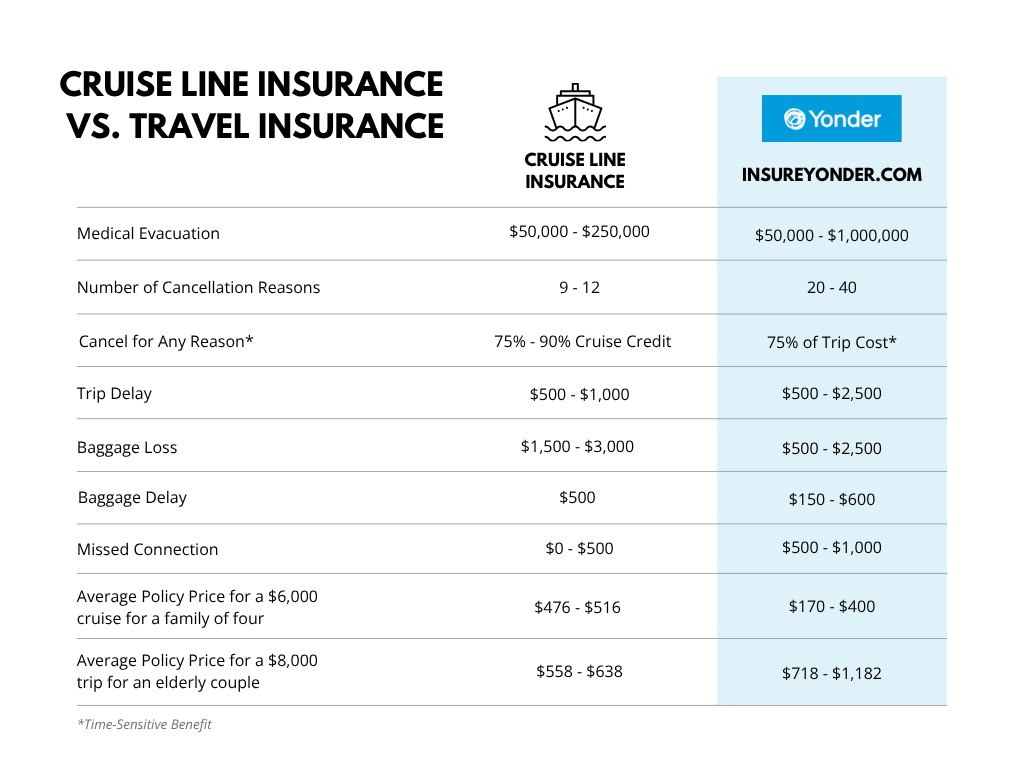
After diving into the plans offered by the leading cruise companies, Yonder uncovered some key discrepancies worth noting. In contrast to general retail travel insurance policies, cruise line insurance typically offers:
11 – 28 less covered reasons to cancel your trip
5 – 20x less medical evacuation coverage
2x less missed connection benefits
We’ve broken it down by benefits and ran a few example quotes in the chart below to see the difference in cruise insurance vs. travel insurance.
Side-by-Side Comparison: Cruise Line vs. Third-Party Travel Insurance
To help you decide which is right for your next sailing, we’ve analyzed the 2026 coverage limits for the major cruise lines compared to the plans available on Yonder.
Criteria
Cruise-Offered Plans
Yonder Comparison Plans
Better Option?
Cruise Line Bankruptcy
Weak. Most cruise-offered plans do not cover the financial default of the cruise line itself, as the policy is sold by that entity.
Strong. Many third-party plans include “Financial Default” as a covered reason for cancellation.
Yonder
Medical at Sea vs. Land
Risky. With limits as low as $20k–$25k (Carnival/Disney), a single night in a ship’s ICU or a private hospital in port can exceed your limit, leaving you to pay the balance out of pocket.
Robust. Yonder offers plans with up to $250,000 of medical expense coverage, so you’re are protected against catastrophic bills in high-cost regions like Europe or the Caribbean.
Yonder
Missed Port (Weather)
Limited. Cruise lines rarely pay insurance claims for a missed port; they usually offer a small onboard credit ($50-$100).
Varies. Some plans on Yonder do include “Itinerary Change” benefits that pay cash for missed ports.
Yonder
Pre-existing Conditions
Convenient. Most cruise lines waive the pre-existing condition exclusion if you purchase the plan at the time of your final trip payment.
Strict. To get a waiver on a Yonder plan, you typically must purchase the policy within 14–21 days of your very first trip deposit.
Cruise Line (for late planners)
Adventure Excursions
Restrictive. Often exclude “high-risk” activities not booked through the cruise line. If you book a private helicopter tour or scuba dive, you may not be covered.
Broad. Yonder offers plans that are built specifically for adventure. They cover more “off-the-beaten-path” activities regardless of who you booked them through.
Yonder
Baggage Delay (Before Embarkation)
Standard ($500). Many cruise lines offer a flat $500. This is helpful if your bags miss the ship and you need to buy clothes at the first port.
Superior ($500–$600). Yonder offers greater variety of plans that offer higher benefit limits and “per day” flexibility for high-end travelers.
Yonder
When Cruise Line Insurance Falls Short (Real Scenarios)
Standalone travel insurance is designed to handle these situations more effectively. Plus, with third-party travel insurance, you’ll also get:
Access to more affordable premiums
Higher insurance coverage amounts per person
Option to increase the amount insured under the policy
Available upgrades to purchase specific coverage
Option to adjust trip dates if you need to reschedule your trip
24/7 emergency assistance
The Payout Gap: How Much You’ll Actually Recover in a Claim
To better understand how the coverage applies between cruise line and third-party coverage during the claims process, these scenarios should provide some insight. Keep in mind that most travel insurance works on a “reimbursement basis”. This means you typically pay upfront for unexpected costs and then file a claim for reimbursement when you return home. The total “out-of-pocket” amounts are based on the assumption the claim was approved.
Scenario 1: The “Heart Attack at Sea” (Medical & Evacuation)
The Event: A traveler has a medical emergency while the ship is in the middle of the ocean. They are stabilized in the ship’s infirmary ($5,000 bill) and then medevaced via helicopter to a specialized hospital in Miami ($75,000 bill).
Cruise-Offered Plan (e.g., Disney or Celebrity):
Medical Coverage: They would cover the $5,000 infirmary bill (Limit is $20k–$25k).
Evacuation Coverage: The limit is $50,000. Since the medevac cost $75,000, the traveler is responsible for the $25,000 balance out of pocket.
Total Out-of-Pocket: $25,000.
Yonder Plan (e.g., Aegis Choice):
Medical Coverage: Covers the $5,000 bill easily (Limit is $50,000k).
Evacuation Coverage: Covers the $75,000 medevac easily (Limit is $250,000).
Total Out-of-Pocket: $0.
Scenario 2: The “Missed Connection” (Flight Delay)
The Event: A severe thunderstorm delays a traveler’s flight to the embarkation port by 6 hours. They miss the ship’s departure. They must book a last-minute flight to the first port of call ($1,200) and stay in a hotel for one night ($300). Total cost: $1,500.
Cruise-Offered Plan (e.g., Carnival or Norwegian):
Missed Connection: Carnival and Norwegian offer no Missed Connection Coverage.
Travel Delay: Carnival covers $500 and Norwegian covers $1,000.
Result: If using a plan like Celebrity ($500 limit), the traveler gets $500 back but must pay the remaining $1,000 themselves.
Total Out-of-Pocket: $1,000.
Yonder Plan (e.g., Battleface Discovery):
Missed Connection: Has a $1,000 limit.
Trip Delay: Has a $2,500 limit.
Result: The plan covers the $1,000 flight (under Missed Connection) and the $300 hotel (under Trip Delay) in full.
Total Out-of-Pocket: $200.
Scenario 3: The “Work Conflict” (Cancel For Any Reason)
The Event: A traveler has a major project come up at work, and their boss cancels their vacation. This is not a standard “covered reason” for 100% reimbursement. The trip cost was $2,000.
Cruise-Offered Plan (e.g., Disney or NCL):
CFAR Benefit: 75% of Cruise Cost as a Future Cruise Credit.
Result: The traveler “loses” $500 and receives a $1,500 voucher. This voucher usually expires within 12 months. If they can’t vacation again within a year, they lose the entire $2,000.
Yonder Plan (e.g., AXA Platinum with CFAR Upgrade):
CFAR Benefit: 75% of Trip Cost as Cash Reimbursement.
Result: The traveler “loses” $500 but receives $1,500 back in cash (check or direct deposit). They can spend this money on anything and are not pressured to book another cruise immediately.
Is Cruise Insurance Ever Enough?
There are limited cases where cruise insurance may suffice:
Short, domestic cruises
Low-cost itineraries
Travelers with strong existing health coverage
Minimal concern about cancellation flexibility
However, for most international cruises or higher-value trips, standalone travel insurance provides better protection.
Who Should Choose Which Option?
Cruise Line Insurance Might Work For
Short, domestic cruises
Travelers with robust international health coverage
Budget trips with minimal nonrefundable expenses
Who Travel Insurance Is Better For
International cruises
Older travelers
Families or groups
Travelers booking flights, hotels, or excursions separately
Cruisers needing special benefits or upgrades
Travelers looking for more robust, affordable coverage
Why Retail Travel Insurance Is Better for Most Cruise Travelers
Before you commit to cruise trip protection, it’s crucial to dive into the policy documents. It’s also important to know that cruises typically issue cruise credits if you cancel. However, third-party coverage pays claims directly to you.
Below are the other areas our travel insurance experts recommend looking into getting coverage for. That way, you and your trip are fully protected.
Insure Flights, Hotels, and Tours
Despite cruise trip protection offering basic benefits, any other expenses you booked outside the cruise could be at risk.
“Cruise policies typically don’t cover expenses for hotels, tours, and flights so it’s wise to purchase extra travel insurance to make sure these expenses are covered if your trip plans get derailed,” says Boynton.
If you’re planning on adding any travel before or after your cruise, it’s best to bundle these and your cruise costs into a single comprehensive travel insurance plan from a third party. That way, you can avoid duplicating coverage and paying twice.
Additional Medical Evacuation Insurance
Because you’ll be on a cruise ship far away from a medical facility, medical evacuations on a cruise can be pricey. Without travel insurance during your cruise, you’ll likely be forced to foot the bill if your health insurance doesn’t extend internationally. Yonder recommends having at least $250,000 in medical evacuation benefits for international cruises.
Cancel for Any Reason (CFAR) Cash Reimbursement
It’s true that some cruise cruise policies provide Cancel for Any Reason (CFAR) coverage. However, they typically only offer cruise credit instead of cash reimbursement. This potentially leads to the loss of your trip value if the credit expires unused. In contrast, Yonder offers Cancel for Any Reason policies that reimburse 75% of the nonrefundable trip cost in cash. Learn more about this flexible cancellation add-on to see if it’s worth it for your trip.
Coverage for Pre-Existing Medical Conditions
For travelers with ongoing medical issues or changes to their health in the last six months, it’s best to get a travel insurance policy that covers already ongoing medical conditions. Most cruise protection plans don’t cover ongoing medical conditions. Many policies on Yonder include pre-existing condition waivers with no extra upcharge.
If you’ve already added trip protection through your cruise line, consider filling in any gaps with additional travel insurance. This way, you’ll know you have coverage for emergencies and travel headaches that could happen before or during your trip.
Bonus Tip: Even if you have credit card insurance, it might not be enough. Yonder did a separate analysis of what credit cards have to offer and they have some major shortcomings when it comes to protecting your trip.
FAQ: Cruise Insurance vs. Travel Insurance
What is the main difference between cruise insurance and travel insurance?
Cruise line insurance usually focuses only on the cruise and offers lower coverage limits. Third-party travel insurance protects your entire trip—including flights and hotels—with higher medical coverage and cash reimbursements instead of cruise credits. You can find these types of policies through Yonder Travel Insurance.
Can I rely solely on cruise line insurance for my entire trip?
Usually not. Cruise line insurance often excludes airfare, hotels, and transportation booked separately. A standalone travel insurance policy typically covers all non-refundable trip costs under one plan.
Why might travel insurance be a better option than cruise insurance?
Travel insurance often includes higher medical coverage, more reasons for trip cancellation, and additional protections such as rental car damage or missed connection benefits, which cruise line insurance policies may lack.
Does cruise line insurance cover pre-existing medical conditions?
Most protection policies offered by cruises do not cover pre-existing conditions. Travel insurance plans from third-party providers often offer waivers or coverage options for these conditions.
How do costs compare between cruise insurance and travel insurance?
Insurance offered by cruises can sometimes be more expensive relative to the coverage offered. Travel insurance purchased independently often provides better value and more comprehensive benefits.
Is cruise line insurance enough for international cruises?
You usually don’t need both. If you already bought cruise insurance, a standalone travel insurance policy can fill coverage gaps. If not, a comprehensive travel insurance plan can fully cover your cruise and trip through a comparison site like Yonder Travel Insurance.
At the end of the day, every traveler should be able to easily access travel insurance that offers them comprehensive coverage at a fair price. Comparing policies pays off—literally—instead of just going with the default option from cruise or airline companies.
Still don’t believe travel insurance can be that cheap? Let our instant quote tool change your mind by providing curated travel insurance for your next trip. You can also let us know what questions you have by emailing our team of helpful humans.
Meagan has spent over eight years at Yonder Travel Insurance mastering the "fine print" so travelers don’t have to. With a background spanning marketing and operations, she specializes in deconstructing complex policy jargon into clear, actionable advice that empowers travelers to explore with confidence. From selecting the perfect plan for a niche itinerary to navigating the intricacies of the claims process, Meagan provides the unbiased, expert travel insurance insights necessary to maximize benefits and minimize risk. By maintaining close partnerships with the travel insurance industry’s top providers, she stays at the forefront of emerging trends, ensuring her readers are always one step ahead of the unexpected.
Lorem ipsum dolor sit amet, consectetur adipiscing elit, sed do eiusmod tempor incididunt ut labore et dolore magna aliqua. Ut enim ad minim veniam, quis nostrud exercitation ullamco laboris nisi ut aliquip ex ea commodo consequat. Duis aute irure dolor in reprehenderit in voluptate velit esse cillum dolore eu fugiat nulla pariatur. Excepteur sint occaecat cupidatat non proident, sunt in culpa qui officia deserunt mollit anim id est laborum
Departure Date Info
Lorem ipsum dolor sit amet, consectetur adipiscing elit, sed do eiusmod tempor incididunt ut labore et dolore magna aliqua. Ut enim ad minim veniam, quis nostrud exercitation ullamco laboris nisi ut aliquip ex ea commodo consequat. Duis aute irure dolor in reprehenderit in voluptate velit esse cillum dolore eu fugiat nulla pariatur. Excepteur sint occaecat cupidatat non proident, sunt in culpa qui officia deserunt mollit anim id est laborum
Return Date Info
Lorem ipsum dolor sit amet, consectetur adipiscing elit, sed do eiusmod tempor incididunt ut labore et dolore magna aliqua. Ut enim ad minim veniam, quis nostrud exercitation ullamco laboris nisi ut aliquip ex ea commodo consequat. Duis aute irure dolor in reprehenderit in voluptate velit esse cillum dolore eu fugiat nulla pariatur. Excepteur sint occaecat cupidatat non proident, sunt in culpa qui officia deserunt mollit anim id est laborum
State of Residence Info
Lorem ipsum dolor sit amet, consectetur adipiscing elit, sed do eiusmod tempor incididunt ut labore et dolore magna aliqua. Ut enim ad minim veniam, quis nostrud exercitation ullamco laboris nisi ut aliquip ex ea commodo consequat. Duis aute irure dolor in reprehenderit in voluptate velit esse cillum dolore eu fugiat nulla pariatur. Excepteur sint occaecat cupidatat non proident, sunt in culpa qui officia deserunt mollit anim id est laborum
Number of Travelers Info
Lorem ipsum dolor sit amet, consectetur adipiscing elit, sed do eiusmod tempor incididunt ut labore et dolore magna aliqua. Ut enim ad minim veniam, quis nostrud exercitation ullamco laboris nisi ut aliquip ex ea commodo consequat. Duis aute irure dolor in reprehenderit in voluptate velit esse cillum dolore eu fugiat nulla pariatur. Excepteur sint occaecat cupidatat non proident, sunt in culpa qui officia deserunt mollit anim id est laborum
Trip Cost Info
Lorem ipsum dolor sit amet, consectetur adipiscing elit, sed do eiusmod tempor incididunt ut labore et dolore magna aliqua. Ut enim ad minim veniam, quis nostrud exercitation ullamco laboris nisi ut aliquip ex ea commodo consequat. Duis aute irure dolor in reprehenderit in voluptate velit esse cillum dolore eu fugiat nulla pariatur. Excepteur sint occaecat cupidatat non proident, sunt in culpa qui officia deserunt mollit anim id est laborum
Deposit Date Info
Lorem ipsum dolor sit amet, consectetur adipiscing elit, sed do eiusmod tempor incididunt ut labore et dolore magna aliqua. Ut enim ad minim veniam, quis nostrud exercitation ullamco laboris nisi ut aliquip ex ea commodo consequat. Duis aute irure dolor in reprehenderit in voluptate velit esse cillum dolore eu fugiat nulla pariatur. Excepteur sint occaecat cupidatat non proident, sunt in culpa qui officia deserunt mollit anim id est laborum
Travel Style Info
Lorem ipsum dolor sit amet, consectetur adipiscing elit, sed do eiusmod tempor incididunt ut labore et dolore magna aliqua. Ut enim ad minim veniam, quis nostrud exercitation ullamco laboris nisi ut aliquip ex ea commodo consequat. Duis aute irure dolor in reprehenderit in voluptate velit esse cillum dolore eu fugiat nulla pariatur. Excepteur sint occaecat cupidatat non proident, sunt in culpa qui officia deserunt mollit anim id est laborum


 Do I Need Travel Insurance for a Cruise?